Mostrando entradas con la etiqueta Zermatt Tourism. Mostrar todas las entradas

martes, 23 de abril de 2013

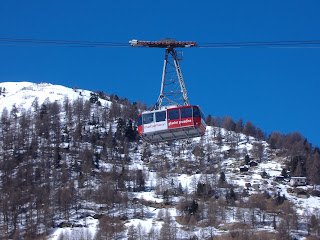
A new funicular for Zermatt

After 32 years the Sunnegga funicular in Zermatt is to undergo a complete refit. By early summer 2013, you will be able to glide up to Sunnegga on new tracks aboard an ultramodern railway. Carrying capacity is to be increased, but there is also a focus on greater comfort for passengers. Entirely new equipment will be installed in the existing tunnel. The necessary structural modifications will be made this summer as well as during the regular autumn break in operations. During an eight-week period in spring 2013, the electromechanical equipment, tracks and rolling stock will be completely replaced. A total investment of about 12 million Swiss francs is planned.
The refurbishment promises a tangible improvement in passenger comfort: the sprung undercarriage and sound-proofed interior will make for a quiet journey. LED lighting will create a pleasant ambience. Passengers will have more room, with the space available for each seat increasing from 0.17 to 0.21m2. The seating capacity of the trains will rise from 170 to 200, which equates to 2570 passengers an hour. To make this possible, the trains will be longer: 30 metres, with three coaches, each of four compartments. The greater length means the floor of the upper compartment will come to a stop level with the station exit. The speed of travel will increase from the present 10m/sec (36km/h) to 12m/sec (43.2km/h). The folding front door will give easier access for goods transport.
The end of the winter season on 22 April 2013 sees the start of eight weeks of intensive work (using a multiple shift system) on all fronts. The aim is to ensure the new funicular is ready for handover and can start operations when the summer season opens on 15 June 2013. Generally speaking, the work will be spread over three seasons, occupying the normal inspection and maintenance periods, in order not to interrupt operations on Sunnegga. Only the spring maintenance period will be extended, by two weeks.
A new funicular for Zermatt

If everything goes according to plan, the opening of the new funicular will take place on Saturday, 15 June 2013! Zermatt Bergbahnen AG is looking forward to the next 30 years and to carrying another 30 million or more passengers on a state-of-the-art funicular.
The Sunnegga area was opened up in 1942 with the installation of a ski and walking lift, which was replaced in 1946 by a chair lift. In the 1970s, with capacity bottlenecks an increasingly frequent problem, it was decided to build a funicular railway. After four years’ construction and a total investment of CHF 26.93 million, it was opened on 28 November 1980. The funicular was recognized far beyond the borders of Switzerland as a genuine innovation in tourist transport systems and soon became a popular attraction. On 3 March 1982, after only 15 months’ operation, the railway was able to celebrate carrying its millionth passenger. By the time of the merger in 2002, the number of passengers had surpassed 17 million. Since then, Zermatt Bergbahnen AG has carried a further 14,129,218 passengers on the Sunnegga funicular, so there is no doubt that it has earned an overhaul! Starting in the winter of 1985/86, the Swiss Federal Office of Transport allowed driverless operation at a reduced speed (5m/sec) and from May 1996 onwards, at the full speed of 10m/sec.

viernes, 26 de octubre de 2012

Zermatt. A Gastronomic Paradise in the Swiss Alps

By Raúl Revuelta

There is no greater pleasure after a long day of skiing than sitting down to enjoy a traditional raclette.
But Zermatt (Valais) offers much more than that. Twenty Zermatt Restaurants have been included in the latest edition of the most popular Swiss restaurant guide, the Gault Millau 2013.

The Omnia, the "Heimberg" Restaurant, and the Hotel Matthiol have entered for the first time in the prestigious guide.


"The residents of Zermatt and their guests are spoiled by the very best mountain restaurants in the Alps. Hotels with ambitious chefs…" The Gault Millau (GM) is full of praise for Zermatt in its 2013 edition. The restaurants included in the 2013 guide (18 up to now) have amassed a total of 248 points (246 up to now). The publishers of the Gault Millau write in their press release: "Gastronomic power continues to rise as before in Zermatt: the cuisine in the wonderful restaurants lining the ski runs is consistently good. There has been some change in the village but the density is impressive". The Gault Millau tasters have designated the boys from the isle of Capri as the undisputed "top dogs", who never cease to "amaze us every year" in the Mont Cervin Palace (Le Capri Restaurant).

The Omnia has been waiting a long time for its Gault Millau entry and now it's a case of "Welcome to the Club!" states the restaurant guide, referring to the 14-point performance by its chef Patrick Weber. The "Heimberg" Restaurant was also able to climb up the rankings. Christian Geisler garnered praise with the entry, "What the young chef from Salzburg, Christian Giesler, serves up, deserves to earn great praise", gaining the "Heimberg" 14 points (13 up to now). The press release goes even further: "Christian Geisler is the shooting star in the village. … we expect great things from him".

The Restaurant Dolce Vita is a new addition, although without an entry with points, as Roland Kilian only works in the Dolce Vita in Zermatt in winter. Like other chefs in Zermatt practically overwinters here like a migratory bird. He is now here for the second time (2012/2013 season).

The Hotel Matthiol also managed only an entry, as Chef Maria Gross is moving on with Patrick Zeh stepping into her shoes. He first needs to prove himself.

Nine Zermatt hotels included Tourists continue to seek out beautiful hotels where they can enjoy outstanding food. Of the 100 hotels designated by Gault Millau as "Gourmet Hotels", nine of them are now in Zermatt. This is because the Hotel The Omnia is now in the club, too. Zermatt has a total of over 150 restaurants, 50 of which are mountain restaurants plus a further 50 bars and nightclubs.

The 20 best restaurants in Zermatt

Gault Millau points


Hotel Alpenhof, Restaurant Le Gourmet15
Hotel Cervo13
Restaurant China Garden13
Restaurant Dolce Vita-*
Findlerhof Mountain Restaurant14
Restaurant Chez Heini13
Restaurant Heimberg14 (+1)
Hotel Matthiol-*
Hotel Mirabeau, Restaurant Le Corbeau d’Or15
Hotel Mont Cervin Palace, Ristorante Capri16
Hotel Mont Cervin Palace, Grill “Le Cervin”14
Restaurant Myoko13
Hotel The Omnia14 (new)
Hotel Post, Restaurant Portofino13
Hotel Schönegg, Restaurant Gourmetstübli15
Hotel Riffelalp Resort, Lounge / Al Bosco13
Hotel Sonnmatten13
Restaurant Zum See bei Max und Greti14
Chez Vrony Mountain Restaurant13**
Grand Hotel Zermatterhof, Restaurant Prato Borni13

*Two Zermatt restaurants have not been awarded points but have still been included. This is because the chef's successor must first prove himself (Matthiol) and because Roland Kilian is "only" working as a guest chef (Dolce Vita). However, he has cooked his way to 16 points in his former Rebstock Restaurant in Tschugg (Berne).

**Chez Vrony (picture attached) is one of a few restaurants that serves their own organic produce. The cattle eat nothing but the grass that grows on the mountain pastures. The dried meat, homemade sausage and mountain cheese served at Chez Vrony is all made according to time-honoured recipes handed down from one generation to the next, just like the restaurant itself. Indeed, all dishes on the menu are natural and authentic regional fare, but are often combined with a cosmopolitan touch.

Gault et Millau is one of the most influential French Restaurant guides. It was founded by two restaurant critics, Henri Gault (1929–2000) and Christian Millau in 1965. Gault Millau rates on a scale of 1 to 20, with 20 highest (Restaurants below 10 points are almost never listed). The points are awarded based on the (1) quality and freshness of produce, (2) creativity and professionalism in food presentation, (3) harmony of the menu, (4) timing of service, (5) presentation and salubriousness of dishes, and (6) consistency of performance.

Based on this rating, high ranking restaurants may display one to four toques.
The Swiss guide was established in 1982. Recognition is highly prized and requires a minimum of 12 points summarised as follows:

12 points. Good kitchen offering conventional and traditional cuisine
13 - 14 points. Very good kitchen with more than conventional cuisine
15 - 16 points. High level of cuisine and quality
17 points. Award for the best quality and consistency
18 points. Award for exceeding quality of cuisine and creativity
19 points. Award for a groundbreaking and outstanding cuisine
20 points. Never awarded

domingo, 18 de septiembre de 2011

Zermatt and Saas-Fee Win Top Recognition for their Environmentally Friendly Transport Systems

By Raúl Revuelta

Fourteen destinations were evaluated by the VCS (Swiss Motor Club): Adelboden, Arosa, Crans-Montana, Davos Platz, Engelberg, Grindelwald, Lenzerheide, Leukerbad, Saas-Fee, Scuol, St. Moritz, Verbier, Wengen and Zermatt. This new "mobile & ecological" rating by the VCS is intended to assist consumers with decision making on winter holidays. The survey was supported amongst others by the STV (Swiss Tourism Association) and the Federal Office for Spatial Development ARE.
 

Zermatt takes 1st place. In second place was Saas-Fee, also car-free, followed by St. Moritz. The Transport and Environment Association gave the highest ratings to Zermatt and Saas-Fee for their excellent rail and bus connections. The two winter hotspots in canton Valais were also recognised for their efforts in promoting public transport.

"For car-free Zermatt, this award is confirmation that our decades of effort and commitment for a sustainable destination are being rewarded", says Zermatt Tourismus Director Daniel Luggen. He is aware that tourism is effectively a balancing act between comfort, growth and improvement of offers on the one hand and sustainability on the other: "We will continue to be committed to sustainability. We’re staying on the ball!".

The Transport and Environment Association also praised other resorts, such as Davos and Grindelwald where local bus rides are free.

Another resort that received special praise was the Lower Engadine resort of Scuol, where "Holidays Without Your Car" packages - that include free access to public transport, separate transport of luggage and electric bicycles for hire - are available.

Among the criteria evaluated were travelling time to the destination, signage, local buses, frequency of public transport and luggage transport possibilities. 

jueves, 1 de septiembre de 2011

Zematt's Ski Pistes Online

By Raúl Revuelta

Since 18 August 2011 it’s been possible to ski several pistes with just one mouse click so that in summer you can see how the runs look in winter. All thanks to Street View in Google Maps.


"With the help of Google Street View, our guests can - at least virtually - skim down the pistes and enjoy fabulous views of the Matterhorn between holidays", says Daniel Luggen, Resort Director of Zermatt. Non-skiers or those who have had enough of the heat in a city office, can now cool down with one mouse click - all thanks to Zermatt’s large fan community. With a public vote, in February 2011 the Swiss population selected its favourite ski area from 30 regions and decided which ski region should be filmed first from the Street View snowmobiles. Around 37,000 people cast their vote and Zermatt was chosen as the favourite ski region – thanks to Zermatt fans!

A survey from March 2011 shows that 53% of all people in Switzerland have used Street View at least once. Street View is also an important tool for planning travel inside and outside Switzerland. The 25% access from abroad shows the popularity of Swiss pictures on Google Maps. Some 1000 Swiss companies, including Switzerland Tourism, have already integrated Google Maps into their websites. 

domingo, 24 de febrero de 2008

Size is important in the Ski Industry

By Raúl Revuelta

I wrote in a recent article about Zermatt how ski resorts have been forced to invest and innovate to remain competitive. Today, I want to focus our attention in all Switzerland. We can found 650 mountain transport and ski lift companies in all the country. They provide access to 12,000 kilometres of ski slopes. With 11,000 employees, the companies are a key economic factor in mountain regions. All together they have a combined annual turnover of approximately SFr840 million.


But most of the Swiss resorts can not compete in the current circunstances. Most of them are small and located in peripheral regions, they have low cash flow, an inability to attract investment capital, and are crippled by high labour costs, services and food. According to professor Thomas Bieger, head of the Institute for Public Services and Tourism at St Gallen University: "The Swiss ski industry is split into two camps: bigger companies (who managed large international resorts) that are innovative and can keep pace with global developments, and too many operators in small ski areas who don't have the means to invest". Bieger told swissinfo that consolidation is one of the answers to the problem. "Only then do you have enough money to make investments". He believes only around 20 of today's 164 medium-to-large ski resorts in Switzerland can be competitive internationally. And the large investments being made by these top 20 are reflected in the price because"If you target the wealthy, you will have stable and higher revenues in the long-run".

Zermatt is one of the Swiss leading resorts with enough capacity to invest to remain competitive, and can afford to focus its attentions on wealthy holidaymakers. But in an increasingly global industry, ski resorts need to look to the international market to found their clients. In Zermatt Swiss market still account for about one-third of all nights spent in local hotels or apartments, but tourist director Daniel Luggen says the number of Swiss visitors has decreased over the past five years and "one of the reasons is that Zermatt has increased capacity (to meet foreign demand)".

Medium-sized ski areas have important reasons to be worried about their future. First of all they do not have the capacity to draw holidaymakers from international markets. Secondly, they have not the capacity to invest in new facilities. For example a recent study found that one in three Swiss ski lift companies could not afford to upgrade its snowmaking infrastructure – considered a vital survival strategy nowadays. They need outside investors to deal with this, but investors are only interested in "integrated" models where the infrastructure – from the lifts and sport shops to the hotels and restaurants – are under single management. But there is no one company running everything in the typical Swiss resort. "Investors need to be able to make money from income streams that aren't completely snow-related", Rusty Gregory, CEO of California's Mammoth Mountain ski area explained in swissinfo: "It's very important to consolidate these income streams before [they] can bring capital in to improve the lifts and other aspects of the resort". These resorts"are only active in small markets and so it will be much more difficult for them to attract capital or foreign investors" Luggen said. "I'm convinced that some of these resorts will have to close in future".